GENOA: THE MYSTERIOUS CHESSBOARD…
GENOA: THE MYSTERIOUS CHESSBOARD…

The Cathedral of San Lorenzo is a majestic building in the historic center of Genoa that welcomes visitors to its namesake square with its striking Gothic portals and black-and-white striped facade, a symbol of Genoese nobility in the Middle Ages. A Catholic place of worship in the city of Genoa, it was consecrated in 1118 in its most basic form, with a single altar and a small surrounding area, but was subsequently expanded over the years until its completion in 1522.
The famous white marble lions holding scrolls, which welcome tourists and worshippers on either side of the cathedral, were added in 1840 by the sculptor Carlo Rubatto to guard the sacred space, as part of a redevelopment of the neighborhood and the lowering of the churchyard.
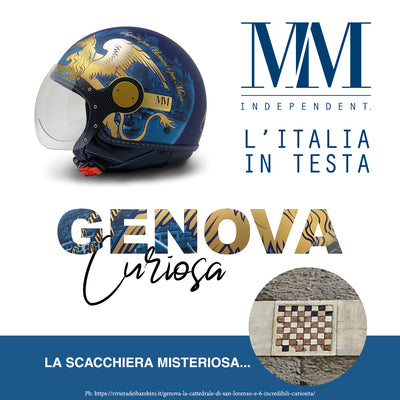
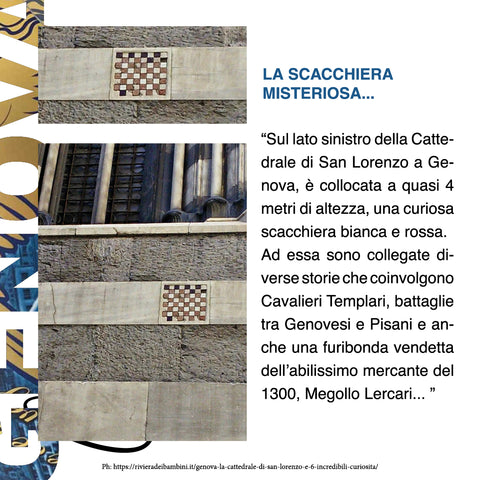
Of the many decorative features on the exterior, perhaps the most intriguing is a mysterious red-and-white checkerboard pattern on the left side, nearly 4 meters above the ground. There are several theories about its presence, each one quite intriguing…
The first, in connection with other symbols found in the cathedral, refers directly to the Knights Templar. In fact, it seems that they were the ones who brought the game of chess from the East, attributing spiritual meanings to it as well: The clear alternation of colors on the chessboard—a motif also found on their battle standard—symbolizes the eternal struggle between good and evil; the pawns, on the other hand, represent humanity, as individuals, fighting step by step, overcoming obstacles and challenges.
The second theory attributes the chessboard to Megollo Lercari, a highly skilled 14th-century merchant and chess enthusiast.
It is said that Megollo traded with Trebizond on the Black Sea, and on one such occasion, he challenged Andronico, the court favorite of his friend Emperor Alexios II. Andronico, who was arrogant and ill-mannered, showed no respect for Megollo or his city of Genoa, insulting them throughout the entire match. The merchant, furious, plotted his revenge, returning to Trebizond armed with two galleys to raid and cut off the noses of the emperor’s subjects until he secured new territories and trade rights.
Finally, the last curious story involves the Genoese and Pisans of the time, who faced off in battle on numerous occasions. One such battle was fought directly on a chessboard by the two doges of the cities. The Genoese doge, who emerged victorious, had the chessboard placed in the cathedral as a token of gratitude and victory, where it can still be seen today.


We would like to thank the following sources for the information provided and invite you to explore the topic further:
_____________________________
Photo credits:
Photo of a Chessboard
Photo of the exterior of St. Lawrence Cathedral
Photo: Jensens, Public domain, via Wikimedia Commons
Photo of the interior of the Cathedral of San Lorenzo
Ph: gnuckx, CC BY 2.0 <https://creativecommons.org/licenses/by/2.0>, via Wikimedia Commons
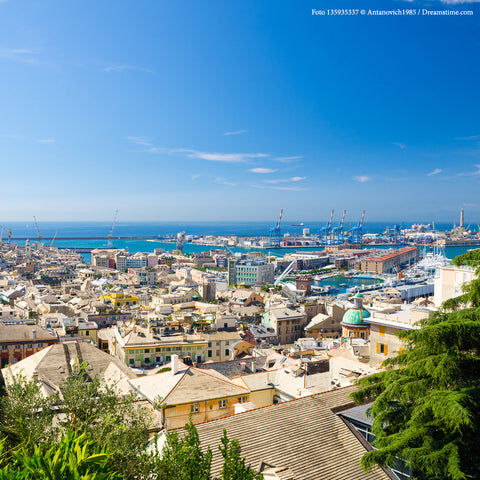
Photos of Genoa
Photo 135935337 © Antanovich1985 / Dreamstime.com